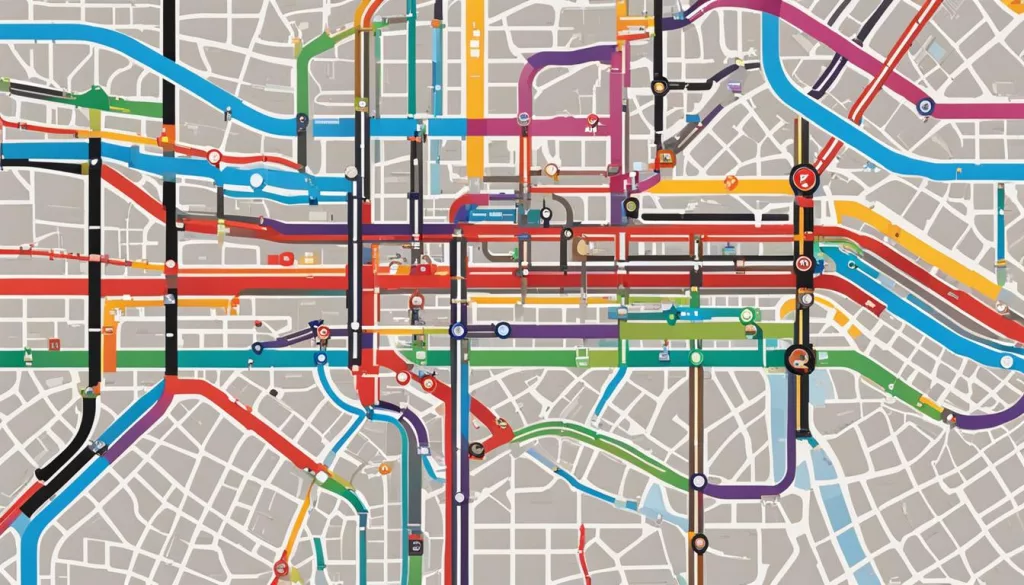
Welcome to our comprehensive public transport guide for navigating the bustling city of London. Whether you’re a local commuter or a visitor exploring the sights, we’ve got you covered with all the information you need to make your journey stress-free and convenient.
London offers a wide range of transportation options, including buses, trains, trams, and the iconic Underground, also known as “The Tube.” With an extensive network of bus routes, well-connected train schedules, and a user-friendly travel planner, navigating the city has never been easier.
As your reliable source of commuter information, we provide a detailed map of London’s public transit system, ensuring you have all the city transportation guide at your fingertips.
With our comprehensive guide, you can discover the most efficient routes, plan your journey ahead of time, and make the most of your time in London. No matter where you’re headed, we’ve got the tips and resources to help you navigate the city like a pro.
Ready to embark on your London adventure? Let’s dive into the details of the Underground, Overground, DLR, Rail Services, Buses, and more. Get ready to explore the diverse neighborhoods and iconic landmarks of this vibrant city with ease and convenience.
Underground – “The Tube”
The London Underground, also known as the Tube, is the oldest underground metro network in the world. Spanning across 270 stations and 250 miles of track, it is a vital part of London’s public transport system. The Tube is an efficient and convenient means of getting around the city, with trains arriving frequently at the stations.
Most tube stations are equipped with entry barriers to ensure ticketed access. Tickets for the Underground can be easily purchased from ticket machines or ticket offices located within the stations. The fare zones system divides London into nine zones, with fare prices varying based on the zones crossed during the journey.
It is worth noting that the Underground can get crowded during rush hour as commuters travel to and from work. To avoid the peak-hour rush, it is recommended to plan your journeys outside these busy periods. Plan your trips accordingly to have a more comfortable and efficient travel experience.
The Tube is not only an excellent mode of transportation within the city but also offers a cost-effective option for traveling from Heathrow Airport to central London. This makes it a popular choice for both visitors and locals alike.
| Benefits of the Underground – “The Tube” | Challenges of the Underground – “The Tube” |
|---|---|
|
|
Overground
The Overground is an excellent alternative to the Underground for traveling above ground. Created in 2007, it serves areas that the Underground does not cover. With the iconic orange logo, the Overground offers convenient and efficient transportation options for commuters and travelers.
The Overground operates on a zone-based fare pricing system, just like the Underground. This means that fares are determined by the number of zones traveled through. The zone-based system ensures that you only pay for the distance you travel, providing cost savings for your journey.
One of the advantages of the Overground is that in most cases, when switching from the Overground to the Underground, touching in and out is not required. This convenience is due to both services falling within the same fare zone. So you can seamlessly transition between the two modes of transport without the need for extra touches.
If you’re looking for a scenic way to explore London or need to reach destinations that are not covered by the Underground, the Overground is the perfect choice. Enjoy the above ground views while traveling in comfort.
Now, let’s take a look at a detailed comparison between the Underground and the Overground in terms of fare pricing and zone layout:
Comparison: Underground vs. Overground
| Fare Pricing | Zone Layout | |
|---|---|---|
| Underground | Zone-based fare pricing | Central area: Zones 1 and 2 |
| Overground | Zone-based fare pricing | Extends beyond Zones 1 and 2 |
As seen in the table above, both the Underground and the Overground operate with zone-based fare pricing. However, the Overground covers areas that extend beyond the central Zones 1 and 2 covered by the Underground.
The Overground’s extensive network, fare pricing, and zone coverage make it a reliable and convenient mode of transport for travelers in and around London.
DLR (Docklands Light Railway)
The DLR (Docklands Light Railway) is an automated rail system that serves the docklands area of London. It provides convenient transportation options for both residents and visitors. The DLR connects London City Airport to the wider tube network, making it an ideal choice for travelers.
The DLR operates in the east and southeast London, serving key locations such as Canary Wharf, Greenwich, and Stratford. It is a popular mode of transport for commuters, as well as those exploring the vibrant docklands area.
One of the advantages of the DLR is its automated nature. The trains are driverless, relying on a sophisticated automated rail system to ensure smooth and efficient operations. This automated feature allows for frequent services and reduces the chances of delays.
When traveling on the DLR, fares can be paid using an Oyster card or contactless payment. Just like the Overground and Underground, passengers need to touch in and out to ensure they are charged the correct fare.
Rail Services
In addition to the Underground, Overground, and DLR, London offers an extensive rail network that connects the city to its suburbs and the rest of the country. These rail services provide convenient and efficient transportation options for both commuters and travelers.
London’s suburban rail services are designed to link central London with the surrounding suburbs. These trains operate within the Transport for London (TfL) system and are a popular choice for those living outside the city center. With frequent services and direct links to various locations, suburban rail offers a convenient way to travel within London.
For those looking to explore beyond London, fast trains provide direct connections to other major cities in the UK. These trains offer a quick and efficient way to travel long distances, allowing you to easily reach destinations such as Manchester, Birmingham, and Edinburgh.
One of the key advantages of rail services is their direct links to major airports. London’s rail network offers convenient connections to Heathrow, Gatwick, and Stansted airports. This means you can easily reach the airport without the hassle of navigating through traffic or relying on other forms of transportation.
Using the Oyster Card
When using rail services in London, it’s important to note that most national rail services operate separately from the TfL system and require a separate fare. However, there are exceptions. Certain destinations and suburban trains within zones 1-9 are included in the Oyster Card system, making it easy to use the same card for both rail services and other modes of public transport.
For example, the Gatwick Express, an airport train that connects Gatwick Airport to central London, is covered by the Oyster system. This allows you to use your Oyster Card to conveniently pay for your journey.
| Benefits of Rail Services | Notes |
|---|---|
| Direct links to suburbs | Convenient for those living outside central London |
| Fast connections to other cities | Efficient way to travel long distances |
| Direct links to airports | Convenient for air travel |
| Oyster Card integration | Some services covered by the Oyster system |
While rail services may require a separate fare in most cases, the Oyster Card remains a valuable payment option for various journeys within London’s transport network. It’s important to check the specific fare requirements for your desired destination to ensure a smooth and hassle-free journey.
Bus
Buses are an essential part of London’s public transport system, with over two billion journeys taken each year. They offer a convenient and cost-effective way to navigate the city, covering a large area and providing access to various destinations.
London’s extensive bus network consists of numerous routes that connect different neighborhoods, landmarks, and transport hubs. From iconic double-decker buses to modern low-floor vehicles, the fleet ensures accessibility for all passengers.
One of the advantages of using buses is the fixed-price fare. No matter the distance traveled within zones, the cost remains the same, making budgeting easier for commuters and tourists alike.
Hopper Fare:
London buses offer a unique feature called the “hopper” fare, which allows passengers to make unlimited bus transfers within one hour of touching in. This means you can change buses multiple times within the hour without incurring additional charges. The hopper fare is incredibly beneficial for those who require multiple connections during their journey, saving time and money.
Paying with Oyster or Contactless Card:
To use the bus, simply touch your Oyster card or contactless card on the card reader when boarding. The card reader is located near the entrance of the bus, typically next to the driver. This touch-in action ensures that the correct fare is deducted from your card.
The Oyster card is a smart payment card that can be topped up with credit and used for various modes of public transport in London. It offers discounted fares compared to other payment methods and provides the convenience of a single card for all your transportation needs. Alternatively, you can use a contactless payment card to pay for your bus journey, which may already be in your wallet.
Hop-on Hop-off Buses:
For tourists exploring London’s main attractions, hop-on hop-off buses are an excellent option. These specialized buses follow specific routes and offer commentary, providing information about the landmarks and their histories. Passengers have the flexibility to disembark at any stop, explore the area, and then catch the next available bus to continue their tour.
Night Buses:
London’s night buses operate throughout the night, providing a reliable transportation option for late-night travel. These buses follow designated routes, ensuring that people can safely reach their destinations even after traditional modes of public transport have ceased operation.
| Benefit | Description |
|---|---|
| Flexible and extensive network | London Bus network covers a large area, connecting neighborhoods and landmarks within the city. |
| Fixed-price fares | Buses offer a flat fare regardless of the distance traveled, making it cost-effective for passengers. |
| Hopper fare | The “hopper” fare allows unlimited bus transfers within one hour, saving money and time for passengers with multiple connections. |
| Payment options | Buses accept payment through Oyster cards or contactless cards, providing convenience and flexibility for passengers. |
| Hop-on hop-off buses | Tourists can explore London’s attractions and landmarks at their own pace using specialized hop-on hop-off buses. |
| Night bus services | Night buses operate throughout the night, ensuring safe and convenient travel for late-night commuters. |
Conclusion
Navigating London’s public transport system can be overwhelming for first-time visitors, but with our comprehensive guide, you can easily get around the city. Whether you prefer the speed and efficiency of the Underground, the convenience of buses, or the scenic routes of trams, there are plenty of transport options to suit your needs.
One of the key tips for easy commuting in London is to use the Oyster Card. This rechargeable smart card provides a hassle-free way to pay for your journeys and offers cost savings compared to buying individual tickets. Simply touch in and out at the start and end of your trip, and the correct fare will be deducted automatically.
Planning your routes and schedules is also essential for smooth travel in London. Take advantage of online travel planners and mobile apps that can provide real-time updates on service disruptions and journey times. Familiarize yourself with the city’s fare zones and transport maps to make informed decisions about the best routes for your destinations.
With our comprehensive guide and these useful tips, navigating London’s public transport system will become second nature to you. So whether you’re a busy commuter or a leisure traveler exploring the city’s iconic landmarks, enjoy the convenience and ease of London’s public transport network.